The full story of the school, since its founding 1994, is described in the book Voices from the Katamonim Neighborhood (Andalus, 2002; in Hebrew), published by the Association of Friends of the Kedma School. Below are translated excerpts from the chapter "Kedma: An Academic High School in the Community" (pp. 77 – 134).

Kedma: An Academic High School in the Community
The Kedma School Looks for a Home How did the Kedma School arrive at the Katamonim-Patt neighborhood? Clara Yona-Meshumar explains: "From the beginning, we thought about a few possible areas in Jerusalem -- Bik'a Talpiot, Ir Ganim, and Katamonim-Patt. We met -- Shlomo Swirsky, Chaya Levy-Sadan, and I -- with Binymain Waller, who was then the director of the post-elementary department of the Jerusalem Education Administration (JEA). It was clear to him at our meeting that we would not open the school. It was just a lot of palaver as far as he was concerned. But he gave us data and he explicitly said: 'The most difficult area in Jerusalem in terms of education, where the JEA has thrown in the towel, is Katamonim-Patt.' That was one of the reasons that we insisted on going there. "There were four of us on the founding staff in Jerusalem -- Michal Cohen, Chaya Levy-Sadan, Rafi Ben Shitreet, and myself. None of us had come from inside the education system. All of us, except for Michal, were single, so we had all day and all night. At that time we didn't have an office of our own so we would meet at my office or in the cafeteria, and we managed all of our work from there. We would sit and plan what had to be done in order to found a school. You need teachers and you need students. So, how do you get students from Katamonim and Patt? We made contacts with the local community center in Patt, and they gave us the names of a few parents from the PTA of the Patt elementary school. We met with the parents at the community center. We spoke to them about the school that we wanted to found. We met with a group of parents every two weeks at the community center, in the evenings. We would talk about education, about tracking, discrimination, about the question of doing a bagrut or not, and about what the Kedma School would offer. "We split up into two pairs and we did house visits. We went to one house after the other. We knocked on the doors. We sat for an hour or two at each home and we told them about the school that we wanted to found in the neighborhood. Mostly, we talked about the fact that children at Kedma would be studying for an academic bagrut and we explained what the importance of that was. When the initial group of parents and students had taken shape, we split up; Chaya and I worked with the parents, Rafi and Michal met with the students one or two afternoons a week and did different activities with them. "We worked hard to bring in students. In addition to conversations with parents, we appeared on the local television station and we talked about the school that would open. We prepared flyers and put them in mailboxes. We put up posters all over the neighborhood. I remember that the principal of the Patt school would always say that Kedma is a school that doesn't even exist. "A lot of parents asked where the school would be opened, whether there was a building, whether there was approval from the municipality. We told them that there was still no building and that approval from the municipality was still on the way, but that there was a vision and an idea, and what's the worst that could happen -- if it didn't succeed they could always go back to the local school. We explained to them that in education, you can make a change. They chose to believe in us." The father of a student from the first class at Kedma tells about the first meetings with the people from Kedma: "We had to send our son to the local school, and he had to go down the same path I went down. I'm a graduate of the local school, 45 years old today. I'm a manager at a garage. When they came to our house and promised my son a bagrut certificate, the truth is I didn't believe them. But I said, 'What do we have to lose?' I don't want my son to work physical labor. If there's a small chance, I'm going to go for it. Today my son can't wait to go to school in the morning. He succeeded on all the bagrut exams that he had until now. When you have nothing to lose you go all the way, and that's what we did."

Studying in Safra Square in Jerusalem
Studying at the City Square The obstacle course that the Kedma School had to surmount in Jerusalem began when the Jerusalem municipality refused to approve the new school. The significance of receiving approval is not only agreement in principle to the school's existence, but also the provision of funds and a school building. The solution that was found in the first year of the school was to include it under the jurisdiction of the Jerusalem district ministry of education, and not under the authority of the JEA. This agreement did not solve the problem of providing a building and a general budget for the school. The people of Kedma had to find a structure for the school themselves, without any assistance or funding from the municipality. Kedma aspired to open the school in the Katamonim or Patt neighborhood, in the community that most of the student population came from. But a suitable building wasn't found for this purpose. Therefore, the first location of the school was a space that had formerly been used as a bank and was located in a residential building in the Gilo neighborhood. The Association renovated the structure at great cost and transformed it into a school. The students would arrive at the school using organized transportation funded by the Association. Clara Yona-Meshumar remembers: "It was some bank branch that over time had turned into a drug alley. We renovated the place and like at the bank, there were huge columns in the middle of the classroom." But this was only the beginning of the school's 'wandering journey.' Residents of the building where the new school was located took out a warrant preventing the school from operating in a commercial area. [The school received an extension from the courts to allow the school to continue operating for a few weeks. However, the municipality took out a parallel warrant prohibiting the use of the property by Kedma.] The significance of this warrant, in practice, was that the school would be temporarily closed. Clara Yona-Meshumar recalls the first day of school: "It was a strange day. In the morning we met the students, we got to know each other and we talked a little about expectations and the curriculum. In the afternoon we went to the courthouse because they had taken out a warrant to close the school. And from there we went straight back to the school for the opening ceremony." [Once the warrant came into effect and the school remained without an official building, classes were held outdoors in Safra Square, across from the municipality. For a short time Kedma also rented classroom space from Beit Shmuel in Jerusalem. During this period, the school conducted a letter-writing campaign to Israeli President Ezer Weizmann, asking for his help to ensure a space for the school. One of the letters written by the students read:]
Dear Mr. President, We are two students at Kedma. The Kedma School is located in the Gilo neighborhood, under a residential building. The residents of the building want us to leave the space because they are not willing to have a school there. We want to be here only for one year. At the end of this school year we will move to another place (we are only two classes in total). Before we arrived at this building there was a bank here, but according to rumors for a long time this place was used as a meeting point for drug dealers. When we came here we cleaned the area and we take good care of it. We are asking for your help to convince the residents to allow us to stay here for only one year. We chose this school because we want to complete 12 years of schooling and succeed in earning a full bagrut certificate at the end, so that we will be able to choose the kind of work we want to do. We enjoy this school and we have everything we need here and all the necessary provisions for us to progress and learn. We are asking for you to answer our request. We wish you success in your role as president and hope things will work out for the best. With thanks, Shlomi Cohen and Nissim Ashuri
A School in a Garage In December 1994 the school moved to a new location in the industrial zone of Talpiot. Until then there were only garages in the area. Clara Yona-Meshumar: "When we were at Beit Shmuel I went to look for a structure and I found a garage in the industrial area of Talpiot. People simply did not understand where a school could be established there. But when I went inside it was like a different world. The garage had a huge hall with very high ceilings. It was expansive in terms of the physical space. There were a lot of separate halls so that in addition to the halls that we turned into classrooms, other halls were turned into an art room, laboratory, cafeteria, gym, computer room, library. We turned another hall into an English room and we wrote all the letters of the alphabet on the wall. "It was terribly cold in winter despite all the ovens we had on. We didn't do a serious renovation because the Association had already spent most of its budget on the structure in Gilo. We painted the walls of the garage ourselves, parents, teachers, and students, and we decorated them. The students loved the place very much. We were in the garage until August 1995."
The Kedma School Moves to a Shack The Kedma School remained at the garage in Talpiot until August 1995 -- the end of the first school year. Over the summer vacation the municipality notified the school that it would help them find a structure. Clara Yona-Meshumar: "We put a great deal of pressure on the mayor that year, including turning to the media. And then, a few minutes before a press conference that the mayor was holding, the director of the municipality called to inform me that the mayor was going to declare that the school would be given formal recognition. And then the person at the municipality who was responsible for the matter of buildings, David Buchbot, arrived. We were very lucky that he was the one in charge during this period. He came to the garage to see the improvisations and investments that we had made in order to adapt the garage to suit the purpose of a school. When he arrived at the garage he was mortified. 'Do children study here?' he asked. And then he offered us the option of moving to a shack in the Patt neighborhood. He said that the shack would be temporary, until another structure would be found, but we understood very quickly that it was in our interest to move there because the budget of the Association had quickly run out and we didn't know if we would be able to pay the transportation budget or the rent in the coming year. "The shack was very cramped. There were no hallways. The classroom door led directly outside into the neighborhood. There was no yard. The shack was located in a playground and it had a sandbox and the like. During the summer it was very hot. During the winter it was very cold and every time it rained -- and it rains a lot in Jerusalem -- it leaked. There were four classes that studied there, 85 students. The parents were shocked at the sight of the shack. The garage seemed a lot better to them by comparison. What encouraged the parents was the municipality's promise that it would be temporary. We were at the shack from September 1995 until June 1996."
Kedma Becomes a Municipal School Clara Yona-Meshumar describes the next stage in the life of the school. "Towards the end of the second school year at Kedma, when we were at the shack, without any elementary structure or municipal funding, Nissim Solomon, the director of the JEA called to inform me that the municipality would support the school on the condition that the school would become a municipal school -- that is, a school under the authority of the municipality and not run by the Association. During that meeting we agreed that if Kedma would consent to this, the municipality would be legally responsible whereas Kedma would only be responsible for the pedagogical side. I raised this possibility before the Association and the PTA and despite the deep apprehension they decided to go with it. "That was the hardest time at Kedma. The money had run out and many of the teachers, including myself, worked without salary for seven months. From February 1995 we worked voluntarily, and we also paid all our own expenses from our own pockets -- transportation, coffee and sugar, office supplies and the like. We would bring my husband Rami and other friends to help us with all kinds of maintenance and to carry out different tasks. Suppliers would call all the time and yell. It was the most difficult period. The thing that gave me strength was the students. The students wanted to keep learning at Kedma. They took on a commitment to Kedma. They felt that they were building the school and that we couldn't let them down."

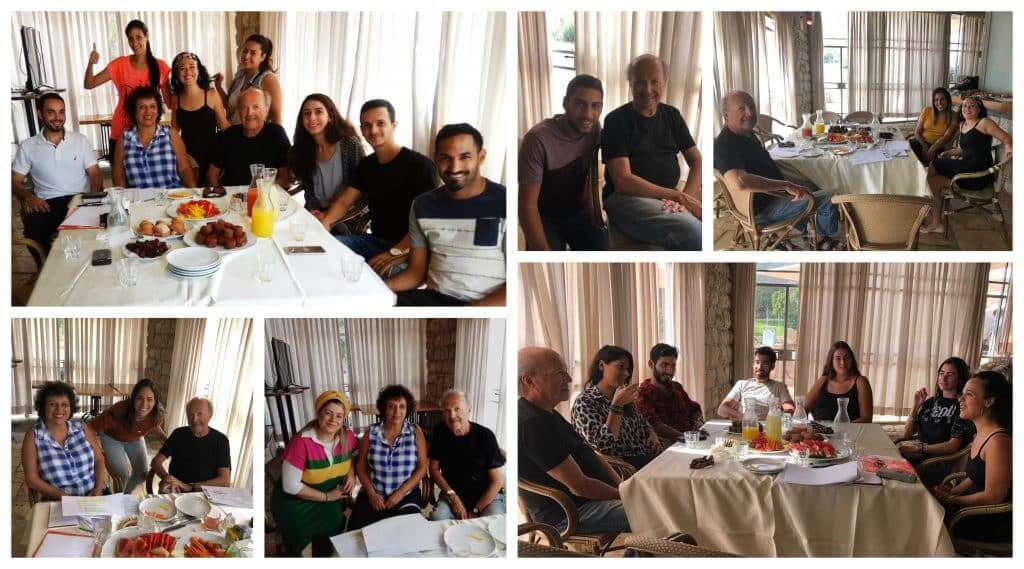
Kedma teachers and parents
Kedma Moves to a Permanent Building In the third year of its existence Kedma left the shack in the Patt neighborhood and moved to a permanent structure, where it resides until today. The building is located in a lot shared with the Ort Sapinian comprehensive school and the Patt elementary school, on Bar Yochai Street in the Katamonim Tet neighborhood. The school sits among a row of long, train-style houses. To reach the school a visitor must cross through an area that was once a run-down park and which today is an abandoned lot. Clara Yona-Meshumar describes the transition to the permanent structure: "In the beginning it seemed like a true luxury. Two floors inside a stone building. The space inside the building was split up into classrooms as much as possible. Sections were divided with plaster walls. Some of the classrooms run width-wise -- the stairs are outside." The present structure is the best among those used by the school since it began its wandering journey. During the first year the structure was spacious and the number of classrooms matched the number of students at the school. However, it still lacks a gym, a laboratory, and other facilities. During each summer the municipality has removed another wall on the border with the Ort Sapinian school, to append another classroom or two to the Kedma School. Today the school contains 6 classrooms for grades 7 through 12.
Addendum In 2003, the Jerusalem municipality expanded the Kedma School by an additional floors, so that the students now enjoy an art and theater workshop, a library, and computer rooms. The Jerusalem Fund (Keren Yerushalayim) also generously renovated the school's entryway and library. |